
Sovereignty Is an Architectural Property.
It Cannot Be Delegated.
A structural analysis of the infrastructure that makes sovereignty over capital possible — and the forms designed to absorb it.
The Emergence of a Concept
For most of modern financial history, the concept of sovereignty over capital did not require active articulation. The paradigm of trust in state monetary authority and banking infrastructure operated as default. Individuals, institutions, and even sovereign wealth holders moved, stored, and transferred value through systems whose legitimacy was rarely questioned in structural terms.
Sovereignty becomes an operationally relevant concept only when the paradigm that contains it fractures. The 2008 financial crisis remains the most recent collective reference point for this kind of fracture — an event where the architecture of trust in central banking, commercial banking, and the broader settlement infrastructure revealed its internal fragilities in ways that could not be absorbed by the existing vocabulary of risk management. The historical specifics are secondary here. What matters structurally is that the event marked the moment when questions previously considered abstract — who controls access to capital, under what conditions, with what recourse — became questions with operational consequences.
What followed was the first technical architecture designed to operate independently of the structural mechanisms that had proven fragile. This architecture did not propose to reform the prior system. It proposed to coexist with it, offering properties that the prior system could not provide by design: immutability of supply, absence of a central issuer, transactability without institutional intermediation, and auditability native to the rail itself.
The analytical question this article addresses is not historical. It is structural. Once a technical architecture of this kind exists, how does sovereignty function as a property of that architecture — and what happens to that property when other systems attempt to absorb, replicate, or reinterpret it?
The answer begins with understanding why the architecture is incorruptible by design, and why that incorruptibility is structurally meaningful rather than technically ornamental.
Architectural Incorruptibility
The Bitcoin protocol is the specific instance of this architecture. Its incorruptibility is not a function of technical perfection — it is a function of what the architecture structurally cannot produce. Value corruption in traditional assets operates through mechanisms the protocol simply does not contain. There is no central issuer who can dilute supply. There is no management whose decisions can distort valuation. There is no institutional layer whose discretion determines access. The absence of these mechanisms is not a deficiency; it is the structural condition that makes incorruptibility possible.
This property becomes visible through a specific observation about the protocol’s gross intrinsic value. Considered in isolation — stripped of adoption, narrative, collective belief, or perceived utility — the gross intrinsic value of the protocol is zero. It produces no cash flow. It generates no dividends, interest, or rents. It cannot be consumed as a commodity. It has no physical or industrial application. It is code operating on a decentralized network.
Most analyses treat this property as a critique of the asset. Structurally, it is the inverse: the gross intrinsic value of zero is precisely what makes the protocol incorruptible. Assets with intrinsic value carry the mechanisms that produce that value — and those same mechanisms are the channels through which value can be corrupted. Fiat currency is corruptible through monetary expansion because it is issued by an entity with the authority to expand it. Publicly traded equities are corruptible through management decisions, accounting discretion, and governance events because their value derives from corporate performance that humans direct. Commodities are corruptible through supply shocks, industrial obsolescence, and substitution because their value is tied to physical use.
The Bitcoin protocol has none of these mechanisms because it produces nothing that could be corrupted through them. Its value does not derive from any process that a central actor can interfere with. Value emerges instead from properties that are mathematical rather than discretionary: programmed scarcity (a maximum supply of twenty-one million units, immutable by design), monetary properties that operate at the protocol level (portability, divisibility, censorship resistance, verification without third-party trust), and the structural absence of a single point of control. These are not features layered onto the asset. They are constitutive of what the asset is.
The subjective value of the protocol — what market participants are willing to exchange for it at any given moment — reflects the perceived worth of these properties in a landscape where traditional alternatives are increasingly constrained by the very mechanisms that define their structure. As governments expand monetary supply, expand reporting perimeters, and expand the scope of administrative control over financial access, the comparative value of an asset that cannot be expanded, reported into, or administratively controlled increases — not because the asset changed, but because the landscape around it did.
There is one additional structural property worth articulating because it often goes unarticulated: the protocol operates in a different temporal register than the institutional systems that compete with it. Traditional financial infrastructure operates in political time — subject to electoral cycles, regulatory revisions, administrative decisions, and the changing composition of the institutions that govern it. The protocol operates in mathematical time. The halving schedule is programmed through 2140. Supply is immutable. The architectural rules cannot be changed by any participant, including the original designer.
This temporal asymmetry is part of what makes sovereignty a durable property of the protocol rather than a provisional feature. An asset whose rules can be revised by future political decisions offers sovereignty conditional on those decisions not being made. An asset whose rules cannot be revised offers sovereignty that is resistant not only to present circumstances but to future circumstances that have not yet occurred. For capital architecture designed to persist across generations, regulatory cycles, and geopolitical shifts, this distinction is structurally meaningful.
Incorruptibility, then, is not an attribute of the protocol. It is a consequence of the architectural choices that define what the protocol is and is not. The protocol was designed to not contain the mechanisms through which value is traditionally corrupted. What emerges from that design is not perfection; it is structural resistance to the specific vulnerabilities that characterize every other store of value available to operators today.

Exhibit IV · Temporal Asymmetry
The question that follows is what happens when other systems attempt to offer exposure to this protocol — or to replicate its properties through their own infrastructure. The answer is the progression of synthetic forms.
The Progression of Synthetic Forms
The protocol’s architectural properties cannot be replicated through external infrastructure without altering what they are. Every attempt to offer exposure to the protocol through an intermediated layer reintroduces one or more of the mechanisms the protocol was designed to eliminate. The synthetic forms that have emerged since institutional interest in the asset became significant are best understood as a progression — not because they arrived sequentially, but because each level of mediation reintroduces a distinct type of corruption risk the underlying protocol does not contain.
Wrapped Bitcoin is the mildest form. The underlying asset exists, but access is mediated through a centralized custodian. The risk reintroduced is counterparty: if the custodian fails, the holder’s access to the underlying units fails with it. Price exposure remains; sovereignty does not.
Exchange-traded funds (ETFs) operate at the next level. The shareholder does not possess keys, cannot move the asset, and cannot transact outside fund-share mechanics. The risks reintroduced are custody risk at the fund level and regulatory risk at the product level. What remains is price exposure, nothing more.
Derivative instruments — futures, options, swaps, structured notes — move further from the asset itself. These are paper contracts referencing the protocol’s price without requiring the protocol to exist in any operational sense. The risks reintroduced are counterparty risk of the issuing institution and price manipulation risk inherent to the derivative market. The holder owns a receivable from the issuer, not exposure to the asset.
Tokenized products issued by banking entities represent the most sophisticated private-sector form. These products use blockchain aesthetics on permissioned networks under institutional control. The risk reintroduced is comprehensive institutional control: the ability to freeze, reverse, and administratively intervene that the underlying protocol makes impossible. Architectural form adopted; architectural substance replaced.
A principle emerges from the progression rather than being imposed on it: the closer an instrument is designed to appear to offer the protocol, the further it is from offering the sovereignty that defines the protocol’s value. The relationship between form and substance inverts as mediation layers accumulate.
The progression is not a catalog of inferior products. Each synthetic has legitimate operational uses. The question is whether any of them provides sovereignty. Structurally, none does.
The State Absorption
The progression of synthetic forms examined in the previous section consists entirely of private-sector instruments. Each is constructed by an actor seeking commercial return through intermediated access to the protocol. The most sophisticated forms of absorption currently in development are structurally distinct because they are not constructed by commercial actors. They are constructed by states — and the state occupies a position no commercial actor can occupy, because the state controls simultaneously the rail it builds and the regulatory perimeter surrounding every alternative rail.
Two approaches are converging globally, and they are operationally equivalent despite appearing opposed.
Central bank digital currencies (CBDCs) represent the direct path: state issuance of digital currency on infrastructure the state controls completely. The currency unit is defined by the state. The rail is operated by the state or by institutions acting under state mandate. The ledger is not public and not distributed in any meaningful sense — it is a permissioned system within the state’s administrative perimeter. Every property the protocol was designed to provide (supply immutability without a central issuer, transactability without institutional intermediation, auditability native to the rail rather than mediated by institutions) is absent by construction. What the citizen receives is the operational convenience of digital settlement, layered onto infrastructure that functions as a more direct version of the banking system the protocol was designed to operate independently of.
State-level adoption of the protocol itself represents the inverse path with equivalent function. The state declares the protocol as legal tender, distributes units directly to the population, and constructs state-operated wallets and applications as the primary interface through which citizens hold and transact with the asset. The protocol exists at the infrastructure level. But the citizen’s access to that protocol is channeled through software the state controls. The state-issued wallet is custodial by default — the state holds the keys on the citizen’s behalf, or the citizen holds keys within an application whose rules the state can modify. The infrastructure is distributed; the access is mediated.
The two approaches converge on a common structural outcome. Both capture the operational properties of the digital rail — settlement speed, cost efficiency, cross-border movement without legacy correspondent infrastructure — and direct those properties toward the state’s operational objectives. Both preserve the state’s perimeter of control over the individual’s access to the rail. In both cases, the citizen gains exposure to the rail without gaining sovereignty over it.
This convergence is not accidental. No government, regardless of its stated posture toward digital assets, has a structural incentive to facilitate genuine sovereignty over capital within its population. Sovereignty over capital at the individual level — the capacity to move value without intermediation, independence from state decisions regarding access to funds, control over keys and custody — operates in structural tension with the state’s natural interests in monetary control, tax enforcement, capital flow management, and sanctions capability. A state that provides infrastructure enabling its citizens to operate entirely outside its perimeter of control has ceded a category of authority that states do not cede voluntarily.
The observation is not a judgment on any specific government’s policy. It is a structural feature of the state as an institutional form. The posture the state adopts publicly — favorable, neutral, or restrictive toward digital assets — does not alter the underlying incentive structure. Favorable regulation facilitates adoption. It does not construct sovereignty. The two are orthogonal concepts.
What this means for the progression is that state-level synthetic forms represent the most sophisticated culmination of the absorption, not because they are technically more advanced than private-sector synthetics, but because they operate with the full authority of the state behind them. A commercial custodian can fail; a state that controls the rail does not fail in the same structural sense — it can modify the rules of the infrastructure it operates, restrict access to alternatives, and extend its regulatory perimeter to cover forms of participation that previously existed outside it. The individual operator who relies on state-mediated access to the digital rail is operating within a system whose rules can be revised by the same entity that operates it.
This is also the point at which the distinction between real sovereignty and simulated sovereignty becomes structurally difficult to perceive. The state-mediated rail uses the vocabulary of sovereignty — financial inclusion, digital empowerment, access to global settlement infrastructure — while constructing the operational inverse. The aesthetic is blockchain. The substance is a single rail under state control. The operator gains exposure to the volatility of the underlying asset without any of the structural benefits the protocol was designed to provide.
The progression that began with private-sector custodial wrappers completes itself in state-operated synthetic infrastructure. Between these two endpoints sits the entire spectrum of mediated access to the protocol. What they share is the property that makes them synthetic regardless of sophistication: they offer proximity to the protocol without the sovereignty that defines the protocol’s value.
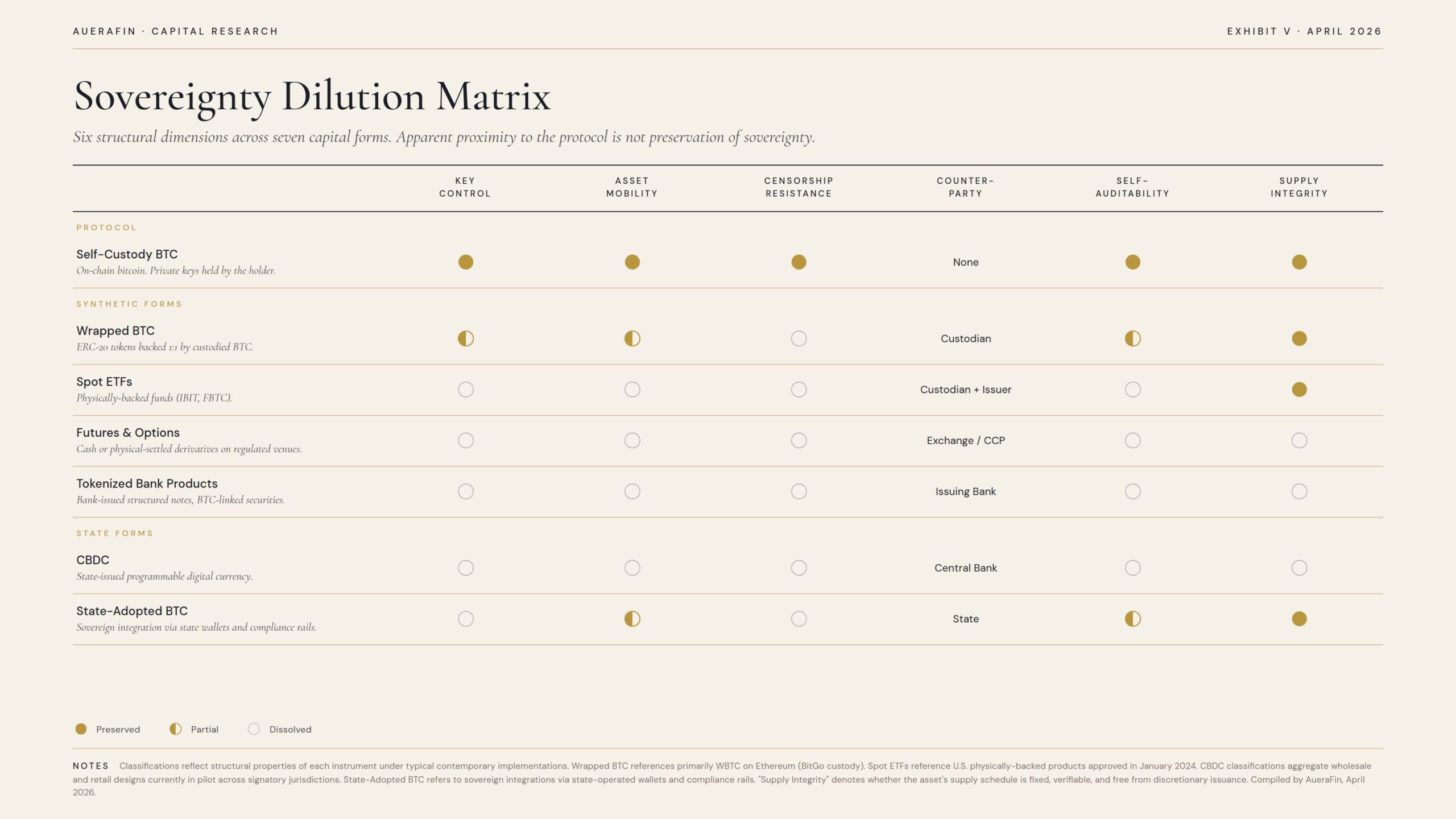
Exhibit V · Sovereignty Dilution Matrix
The Architecture of Preservation
The analysis to this point establishes that sovereignty over capital is a property of specific infrastructure, that synthetic forms reintroduce the corruption mechanisms the infrastructure was designed to eliminate, and that state-level absorption represents the most sophisticated form of this reintroduction. What remains is the operational question: how does an operator preserve the property when the surrounding system is structured to dilute it?
The answer is hybrid rail architecture designed from inception. The term requires precision because it is used loosely in institutional contexts, often to describe asset allocation that includes digital exposure alongside traditional holdings. That is not what the term means here.
Hybrid rail architecture, as a structural discipline, is deliberate allocation of capital flow across the banking rail and the digital asset layer such that neither rail is a single point of failure for any critical function. It is not a reallocation of assets within a single infrastructure. It is a redistribution of dependencies — custody, settlement, liquidity access, cross-border movement, and operational continuity — across infrastructures whose failure modes are structurally different.
The operator who builds this architecture remains fully within the compliance perimeter. Regulated entry and exit points continue to handle KYC, source-of-funds verification, and tax reporting as a function of the intermediaries’ licenses. The architecture does not propose operating outside the regulated system. It proposes distributing critical functions such that the failure of any single regulated component does not compromise the operator’s capacity to preserve and deploy capital. This distinction matters because the architecture is defensible on its own terms: it operates with full auditability, full substance, and full legitimacy within every jurisdiction in which it touches regulated infrastructure.
What distinguishes the architecture from conventional wealth structuring is the treatment of the digital asset layer as a legitimate rail with operational properties that banking infrastructure cannot replicate — not as an asset class to hold, but as a parallel infrastructure to coordinate. Custody control, settlement speed, native traceability, and cost structure are rail properties, not asset properties. The architecture integrates these properties into the operator’s overall capital structure alongside the banking rail rather than treating the digital layer as a subset of the banking rail’s portfolio.
The Illusion of Single-Rail Revenue
An operator who states revenue figures while operating entirely within banking rails is stating a figure with invisible conditionality. Revenue of a given magnitude, held and transacted through banking infrastructure exclusively, is conditional on the banking system permitting access, the regulatory system not altering rules in ways that affect the operator specifically, correspondent banking relationships maintaining cross-border mobility, the operator’s jurisdiction avoiding sanctions or capital controls, and the specific institutions the operator uses remaining solvent and operationally continuous.
None of these conditions are paranoid. Each has been demonstrated historically within the memory of currently operating senior executives. What is distinctive about their current combination is that all of them have become more dynamic than they were a decade ago — regulatory change accelerates, correspondent banking tightens, sanctions scope expands, and institutional continuity has become a variable rather than an assumption.
Single-rail revenue, in this structural sense, is not sovereign wealth. It is operational concession from the system. The operator does not possess the capital in the sense that sovereignty implies possession; the operator accesses the capital under conditions the system permits. The distinction becomes visible only when the conditions change — which is also the moment when the distinction becomes irreversible.
Creating Infrastructure Versus Renting It
The distinction between constructing architecture and purchasing access to existing structures is worth articulating because it is rarely made explicit. Traditional cross-border wealth structuring — offshore holding companies, foreign custody accounts, treaty-advantaged jurisdictions — operates by renting access to regulatory and operational perimeters constructed by others. The operator pays for the use of a structure whose terms are controlled by the jurisdiction, institution, or intermediary that constructed it. When those terms change, the operator renegotiates or relocates.
Hybrid rail architecture constructed from inception operates differently. The operator builds proprietary structural capacity — self-custody within regulated frameworks, multi-rail settlement coordination, cross-jurisdictional operational distribution — that does not depend on any single external structure remaining available on current terms. When the landscape changes, the architecture integrates the new terms rather than requiring replacement.
This distinction has strategic implications for operators building wealth across jurisdictions. An architecture that depends on renting external structures becomes fragile as the global regulatory landscape converges, because the asymmetries that made those structures attractive are the first asymmetries to compress. An architecture that is built from inception with compliance-legitimate properties at every layer integrates regulatory convergence without structural disruption, because the architecture was never dependent on asymmetry to function.
Organic Integration as Regulatory Convergence Proceeds
International frameworks extending reporting obligations and transparency requirements to the digital asset layer are implementing across signatory jurisdictions through 2026 and 2027. The trajectory is toward convergence rather than fragmentation. Operators who have not constructed architecture before this convergence will face retroactive adaptation — restructuring custody arrangements, migrating settlement infrastructure, generating tax events in the process of compliance, and in many cases accepting less optimal structures because the window for deliberate design has closed.
Operators who construct architecture now, with full compliance and auditability built into every layer, face a different trajectory. The architecture they build will become visible to the new reporting frameworks without requiring structural modification. What changes is the reporting perimeter; what does not change is the architectural distribution of custody, settlement, and operational continuity across rails. The architecture integrates the new regulatory landscape organically — it was never designed to exploit the absence of reporting; it was designed to function with reporting as a constant.
This is what makes the current window meaningful. The window is not for regulatory arbitrage. The window is for constructing infrastructure before the process of constructing it becomes substantially more constrained by the regulatory trajectory now in progress.
The Structural Principle
Sovereignty over capital is an emergent property of specific technical infrastructure. It exists where the infrastructure’s architecture makes it possible, and it ceases to exist where the infrastructure’s architecture prevents it. The property is not a declaration. It is not a regulatory status. It is not a policy orientation. It is a structural consequence of how the rail is built and how the operator’s relationship to the rail is structured.
When a system absorbs infrastructure that was designed to provide this property, the property does not survive the absorption. It is diluted through mediation, erased through intermediation, or simulated through aesthetic replication. What remains is exposure, access, or participation — none of which are equivalent to sovereignty.
The protocol at the center of this analysis did not gain value despite having no intrinsic value. It gained value because its architectural properties could not be produced by any system that preceded it, and because the structural problem it addressed — who controls access to capital, under what conditions, with what recourse — became operationally relevant in a landscape where the prior system’s fragilities are no longer hypothetical.
Preserving this property as the surrounding landscape evolves requires architecture that is designed for it from inception, not adapted to it after the fact. The operator who constructs capacity now, with full compliance and full auditability, operates within every framework the regulatory trajectory is producing. The operator who delegates the function to the system the property was designed to operate independently of will learn the distinction at the moment the distinction matters.
AueraFin operates in this specific territory. The firm’s work is the coordination and design of hybrid rail architecture for cross-border operators whose capital structure makes architectural distribution operationally necessary. The analysis in this article reflects the conceptual foundation of that work rather than a description of its execution.
This framework reflects independent structural analysis based on publicly available data, institutional reports, and direct professional observation. It does not constitute investment advice, a solicitation to buy or sell any security, or a recommendation regarding any specific transaction. Readers should consult their own professional advisors before making any capital allocation or structuring decisions.